Business in the process of change: Opportunity in a world full of waiting
InsightIn the first of a new Grant Thornton series on current international business trends, we explore how the changing economic environment can offer growth...
By: Grant Thornton
April 30, 2025 6 min read

In the first of a new Grant Thornton series on trending international insights, we examine the wider impact of tariffs on the mid-market. The dip in market confidence at the start of 2025 was just the start of more to come.
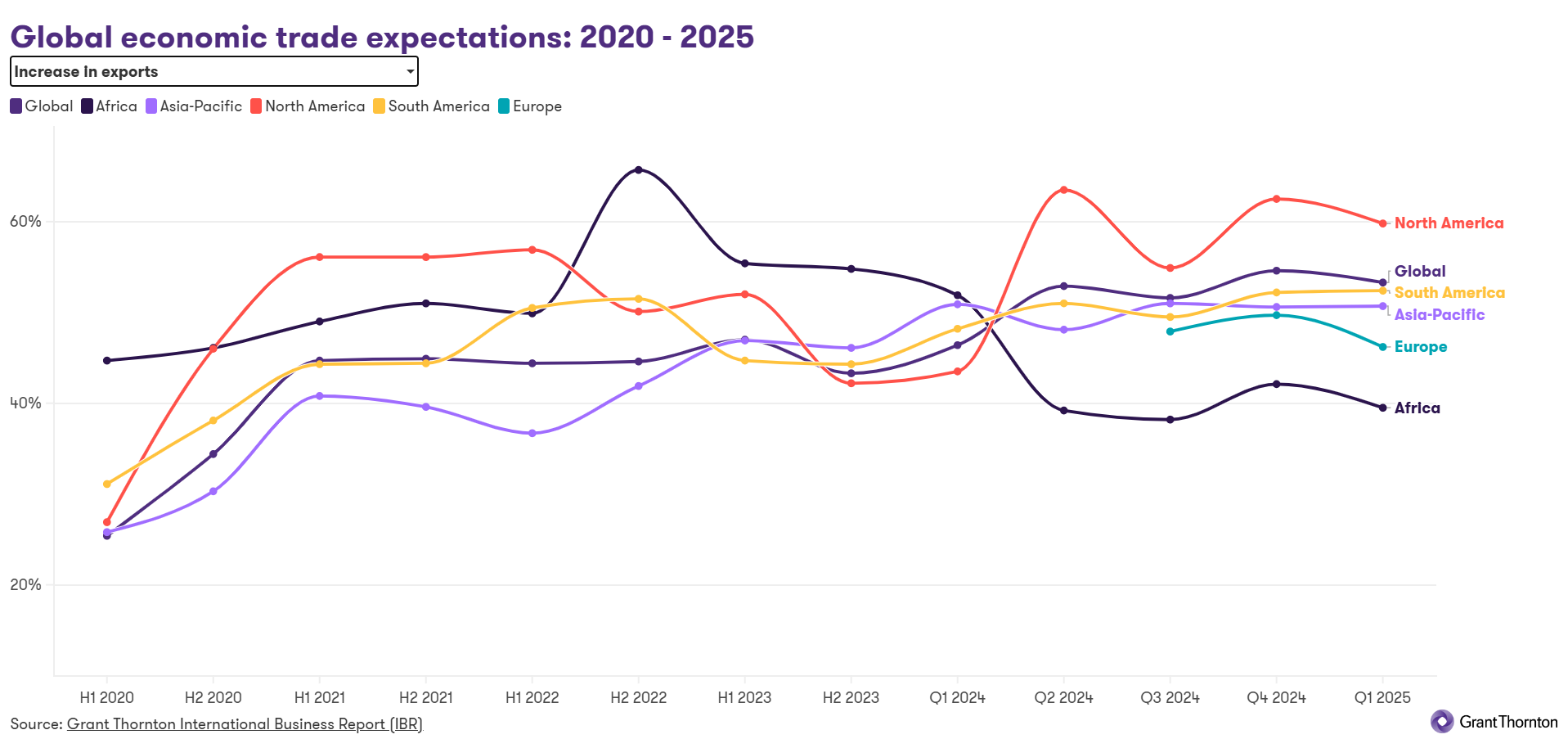
At the close of 2024, mid-market businesses were riding a steady wave of optimism. According to Grant Thornton’s International Business Report (IBR) research 54.6% of mid-market firms plan to increase their exports and 50.3% expect to grow their revenues from international markets. However, as we entered 2025 trade tensions escalated, with optimism experiencing its first notable dip in two years (down 2.9pp to 72.7%). Despite the early signs of caution emerging among mid-market leaders, the underlying fundamentals – rooted in agility and strategic foresight – remained relatively robust.
Graphic – historical economic trade expectations
The current wave of new tariffs has proven both unexpected and unprecedented, with the OECD warning that they could take a “significant toll” on worldwide growth. What began as isolated measures has morphed into an uncertain and complex global trade landscape, with the parameters changing on a near daily basis. And at a time, when heavy trade barriers are part of everyday business, market disruption is very real.
As opportunities in traditional global export markets continue to shift, businesses are facing the reality that new trade dynamics may significantly alter their growth trajectories. Companies now need to be more strategic than ever, maximising their value in domestic markets and looking to do more business regionally.
Mid-market businesses are no strangers to navigating severe challenges. Over the past number of decades, these firms have successfully weathered the Global Financial Crisis, managed the widespread disruptions brought on by COVID and adapted to a whole host of severe supply chain disruptions.
What makes today’s volatile turnarounds on tariffs unprecedented however, is that throughout all of these prior crises the mid-market could focus on their portfolio of non-domestic business to grow despite market turbulence – today’s tariffs are diminishing that option, forcing firms to reassess their addressable markets and potentially adjust their business models.
Businesses should assess both exposure and risk, adjust supply chains in light of this turbulence and look to understand the true value of their products and services in the context of opportunities in emerging markets.
In this constantly evolving landscape, the enduring principles that define the mid-market – focus, agility, and strong leadership – have never been more critical. These core attributes are what empower firms to respond swiftly to new challenges and pivot as needed. Strategic shifts are already being observed, with many companies now looking to concentrate on a select few markets with the most promising prospects – the number of countries businesses are looking to sell to has already decreased (down 3.7pp to 47.8%).
This more focused approach not only maximises resource allocation but also enhances their ability to manage complex tariff-induced changes.
Faced with the reality of a fragmented global market, some mid-market businesses may soon confront the difficult decision to scale down or even halt trade in markets where tariffs make continued engagement unsustainable. For many, this could mean rethinking traditional strategies in favour of structural adjustments – altering contract terms, reconfiguring payment structures or even reimagining supply chain logistics. While these decisions are challenging, they are sometimes necessary to help mitigate impact and safeguard long-term competitiveness.
Graphic – 31.8% of mid-market leaders at the end of 2024 planned to spend most resources preparing for supply chain interruption as a potential issue.
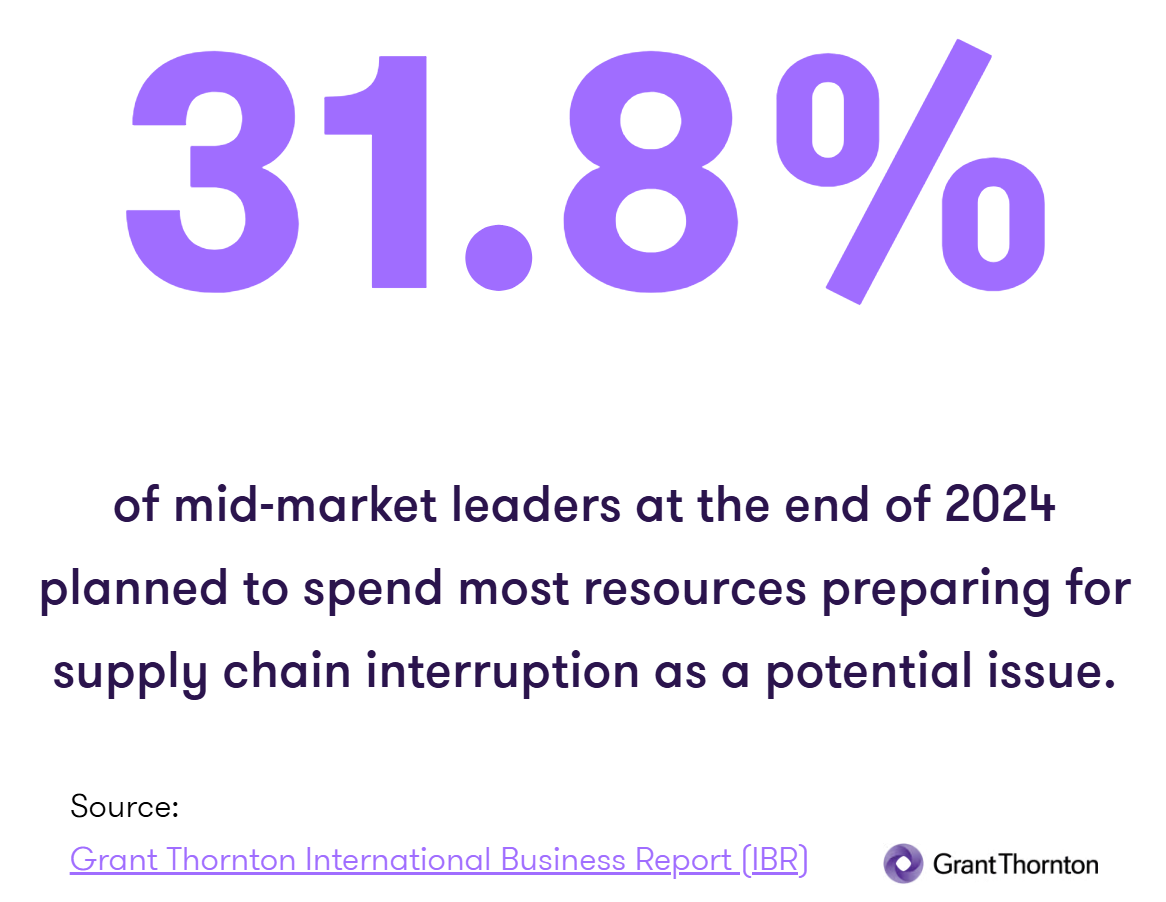
We’ve already seen the mid-market begin to shift resourcing when it comes to key areas such as supply chain resilience. By the end of 2024, nearly one third (31.8%) of mid-market leaders planned to spend most resources preparing for potential supply chain disruption. This is almost fourfold increase from the 8.3% who cited supply chain issues as their most significant risk in the previous measurement.
The unavoidable fact right now is that change is constant. Beyond just tariffs, mid-market leaders face numerous transformative challenges: AI as part of their digital transformation, evolving cyber threats, climate change (and regulation) and demographic shifts. Yet the same qualities that help them navigate trade barriers – agility, foresight, and purpose-driven leadership – position them well for handling these other challenges, too.
The global economy may suffer further as trade tensions and uncertainty persist, but if there’s a silver lining, its likely to be found in the mid-market – the most resilient and opportunistic segment of the business landscape. Where strong scenario planning will be key and, for those who get it right, new doors may begin to open. In what seems like a zero-sum game of global tariffs, don’t be surprised if many mid-market firms emerge as unexpected winners.

In the first of a new Grant Thornton series on current international business trends, we explore how the changing economic environment can offer growth...



The so-called Chip Act is a key agreement for the European Union, which is currently struggling with high dependence on external semiconductor suppliers. The...

The government has approved the Operational Programme Employment Plus, due to which our country can receive EUR 1.459bn from European funds in the period...

At its meeting, the National Accounting Council (NAC) approved an interpretation relating to the accounting solution of a vacated share and settlement share...

Prolongation of deadlines for the notification requirement for cross-border arrangements

On 9 October 2019, and amendment of act no. 112/2016 Coll., on the use of electronic cash registers, promulgated under number 256/2019 Coll. was published in...

In May 2020 the amendment to the Act on Electronic Records of Sales comes into effect. It concerns entrepreneurs who belong to the 3 rd and 4 th phases. That...
The SAC issued a ruling on February 7 th , 2019 by which it denied the complaining party’s appeal in cassation.
The government has approved an amendment of the foreign exchange activity act, which should take effect on the first day of the third calendar months after...