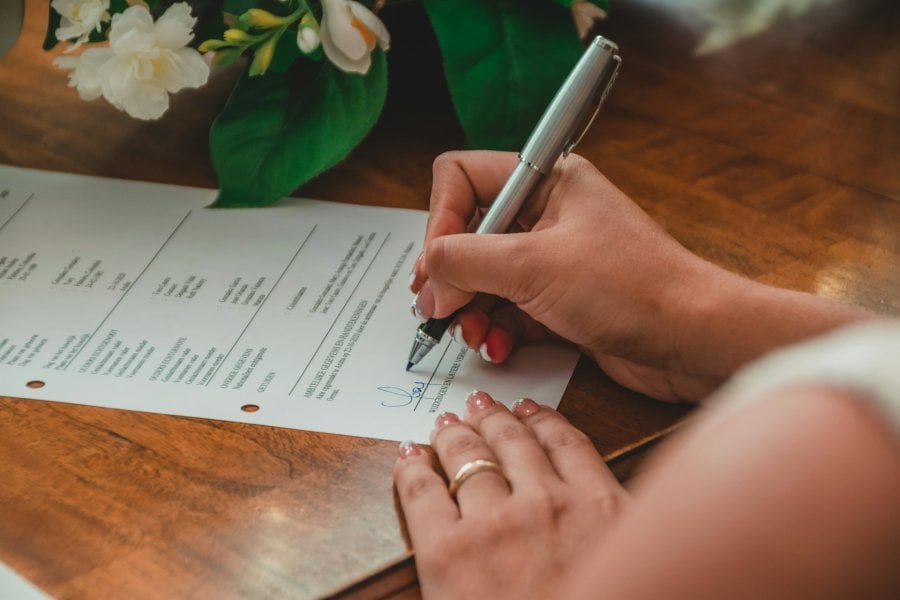
Most people associate signature verification with a notary or a Czech POINT. Did you know that signatures can also be verified by a lawyer?
This verification is performed by a lawyer on the basis of a declaration of authenticity of the signature.[1]
When is verification by a lawyer not possible?
A lawyer cannot verify the signatures of certain persons,[2] namely signatures of:
- the lawyer in question;
- persons close to him (including, but not limited to, siblings, parents, children, spouse[3]);
- his representative for the verification of signatures;[4]
- the principal on a power of attorney if the lawyer is the agent under that power of attorney (unless it is a power of attorney in a proceeding).
For the sake of completeness, it may be added that signature verification is not possible in other cases, including:
- on a document that contains no text,
- in the case of a document that is not written in Czech, Slovak or any other language that the verifying lawyer knows,
- if the person to be verified does not present an ID card or other official document,[5] or his or her identity cannot be established;
- if it is a completely blank form;
- if the person acting is different from the person whose signature is to be verified;
- if the person acting cannot write and the document does not contain his or her signature.
Can signatures be verified in other cases where the lawyer may not be impartial?
Although not expressly prohibited by law, the courts have also questioned the verification of the signature by a lawyer who, in their opinion, was not impartial. Specifically, this was the case when an attorney verified the signature of a representative of the other contracting party on a document that he himself had signed.[6]
According to the Supreme Court, however, the impartiality of the lawyer in verifying the signature is not required.[7] Even according to the Civil and Commercial Chamber of the Supreme Court, it is not relevant for the validity of the declaration that the lawyer who certified the signature of the party’s representative was also the representative of the other party.[8]
Consequences of defects in the declaration of authenticity of a signature issued by a lawyer
It is clear that defects in the declaration and breaches of the lawyer’s duties in making it may render it invalid. However, the Supreme Court has already acknowledged[9] that not all defects necessarily result in the “absence” of the declaration (and thus the absence of official verification of the signature). It is necessary to protect the legal certainty of the contracting parties who rely on the declaration without having a realistic opportunity to assess whether the lawyer has acted in accordance with the relevant regulations of the Czech Bar Association.
Conclusion
Lawyers can officially verify signatures by means of a declaration of authenticity.
A lawyer is entitled to verify the signature of a party to a document, even if he himself has signed the document as a representative of the other contracting party (unless there is another reason why the signature cannot be verified).
Not every violation of the lawyer’s duties in verifying the signature will invalidate the declaration of authenticity of the signature.
[1] Section 25a(1) of Act No. 85/1996 Coll., on the legal profession, as amended.
[2] Section 25a of the Act on Advocacy, Article 3(1) and (2) of the Resolution of the Board of Directors of the Czech Bar Association of 11 April 2006, which sets out details on the obligations of attorneys when making declarations of signature authenticity, keeping records of such declarations, on the higher verification of these declarations, and on the book of declarations of signature authenticity (resolution on the attorney’s declaration of signature authenticity), as amended.
[3] A close person is defined in Section 22(1) of Act No. 89/2012 Coll., the Civil Code, as amended.
[4] This may only be a trainee lawyer employed by the lawyer in question, or an employee of the company in which the lawyer practices law as a partner, provided that the trainee lawyer has submitted an officially certified specimen of his or her signature to the Czech Bar Association; Article 4(2) of the Czech Bar Association’s resolution on the declaration of authenticity of signatures; Section 25a(5) of the Act on the Legal Profession
[5] Such an identity document must contain the name and surname of the person, his/her likeness, date of birth and place of birth; Article 7(1) of the Czech Bar Association’s resolution on the declaration of authenticity of the signature.
[6] Resolution of the High Court in Prague of 23 May 2023, No. 7 Cmo 56/2021-392.
[7] [7] Paragraph 28 of the Supreme Court’s Resolution No. 27 Cdo 3120/2023 of 8 January 2025
[8] Supreme Court Press Release: The headnotes of the decision approved at the hearing of the Civil and Commercial Chamber of the Supreme Court on 8 October 2025, press release available HERE
[9] Paragraph 29 of the Supreme Court Resolution No. 27 Cdo 3120/2023 of 8 January 2025