The latest data from the Czech Statistical Office show that the research and development (R&D) tax credit is used by only a minority of eligible companies despite changes in legislation and simplification of some conditions. Yet, this is an area that could be very attractive for companies. The attraction lies in the possibility to claim the de facto actual costs of the R&D project twice, once as a tax-deductible cost and once as an item deductible from the tax base.
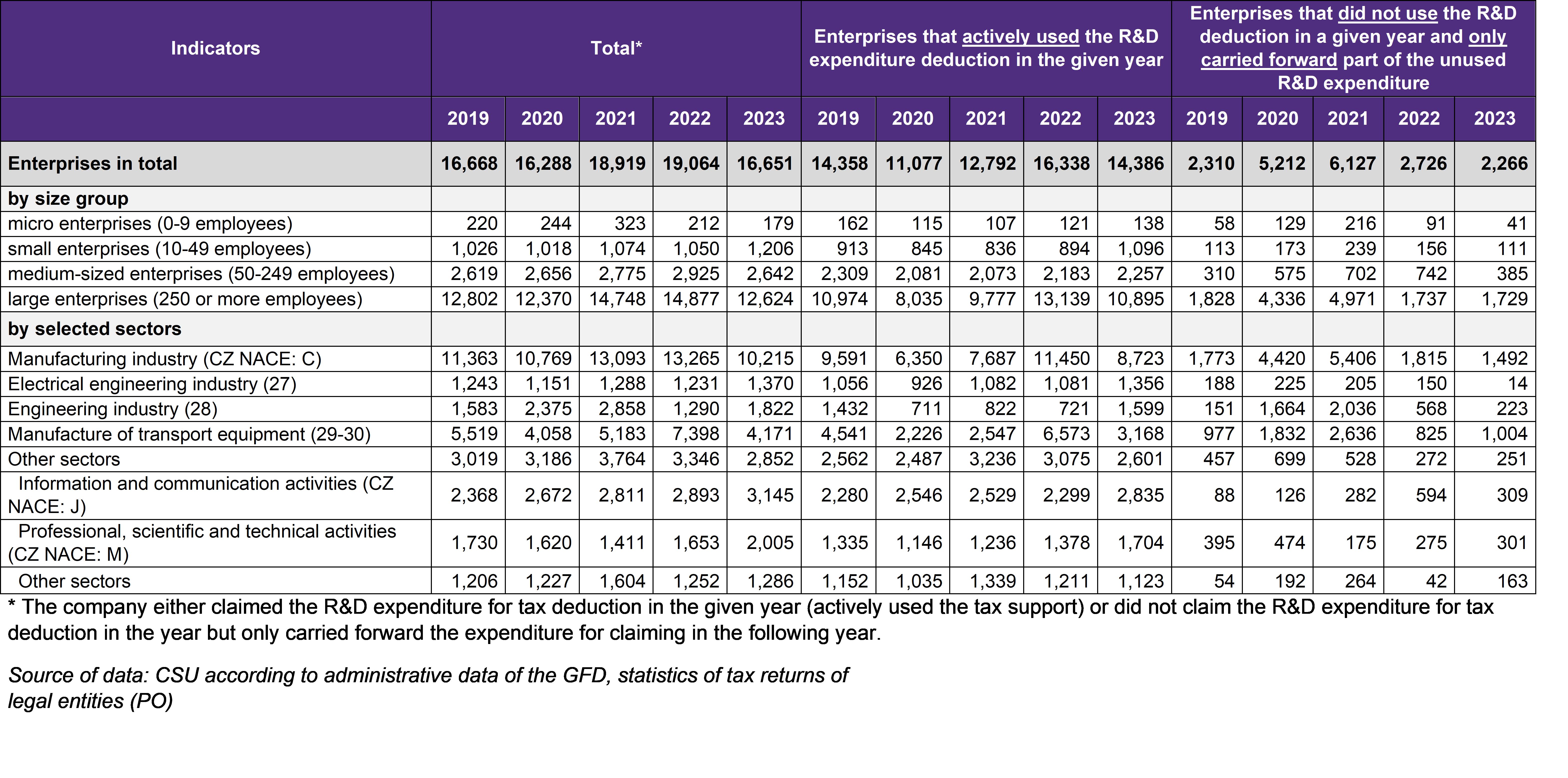
According to data from the Czech Statistical Office, almost 3,000 private companies were engaged in research and development activities in 2023, but only 731 of them claimed the deduction. This corresponds to approximately one quarter of the total number, while in 2015 more than half of them benefited from this tax support. According to data from the Czech Statistical Office, private companies deducted CZK 14.4 billion in research and development expenses from their income tax base in 2023, i.e. CZK 2 billion less than in the previous year. At a tax rate of 19% (today 21%), companies saved CZK 2.7 billion due to this indirect public support. Large enterprises saved CZK 2.1 billion in taxes in this way, while the remaining CZK 0.6 billion went to small and medium-sized enterprises. Companies in Prague and the Central Bohemia Region claimed more than half of this tax support. For 2023, they used 16% of their total R&D expenditure on R&D as tax credits, in the year 2015 it was nearly 30%.
Total amount of R&D expenditure deducted or transferred (CZK million):
![tabulka-en-fin.png (648 KB)]()
We believe that a common reason for the low use is caution on the part of companies, fear of tax audits and uncertainty about meeting all formal requirements. Many businesses perceive the application of the deduction as administratively demanding and risky – in case of deficiencies in documentation, they fear possible disputes with the tax authority. In practice, many companies therefore do not take advantage of the R&D deduction.
The rules for claiming the deduction have evolved in recent years and should be clearer for taxpayers. From April 2019, there is an obligation to notify the tax authorities of an intention to claim a deduction for a particular project before the project expenditure is claimed. It is not necessary to have the project documentation prepared before the work starts – it is sufficient to have it prepared and approved by the end of the deadline for filing the tax return for the relevant period (we have covered this topic more here). From 2024 onwards, it is also possible to prove the legal requirements of the documentation by other means of evidence (see also more in our article here). These modifications are aimed at limiting situations, where the deduction is rejected on purely formalistic grounds.
Although the control practice remains strict and the activity of tax administrators is not relenting, the development of the rules shows an effort to reduce uncertainty and strengthen the legal certainty of taxpayers. This may also be an incentive for companies that are not yet using the deduction, even though they could potentially benefit from it. It is always necessary to compare the tax saving (lower tax liability) with the cost of establishing the records of such costs and preparing the project documentation. If you are interested, we will be happy to help you with the entire process of claiming the R&D deduction, both in terms of setting up the processes and preparing or revising the necessary documentation and calculations.